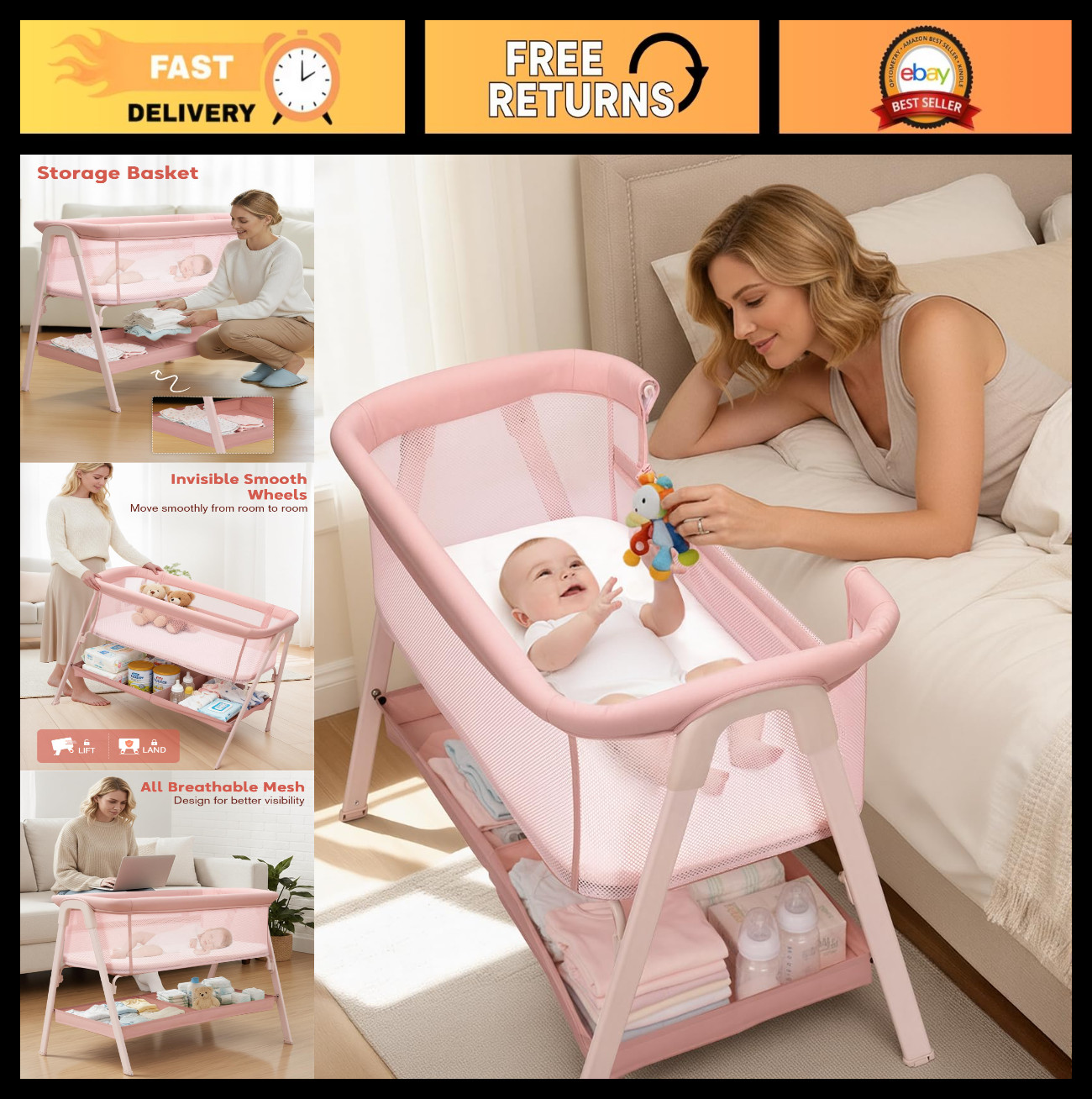

Photos from current listings. Actual item, color, and included accessories may vary.
Co Sleeper Buying Guide
A co-sleeper is a bedside bassinet that attaches to the adult bed, letting you soothe and feed your baby without getting up. The core trade-off is between a firm, breathable mattress and adjustable height/attachment hardware that must match your bed frame exactly. Choose a co-sleeper only if it has a rigid frame, a flat firm mattress, and a secure strap system; skip any soft-sided or unanchored model.


At a glance
- Category
- Baby Sleep & Soothing
- Data updated
- Nov 15, 2026
Current offers
Highlights
- Bedside co-sleepers use a drop-side panel or open side to align with the adult mattress; the panel must lock securely in the raised position for standalone use.
- Mattress firmness is the safety-critical spec: a co-sleeper mattress should be flat, less than 1 inch thick, and firm enough not to conform to the baby's head.
- Adjustable height ranges typically span 13 to 22 inches from floor to rail top; you need a model whose range covers your bed height minus mattress top.
- Attachment hardware varies: strap-and-buckle systems anchor to the adult bed frame, while some models rely on a base that slides under the mattress; straps are more secure.
Best use cases
- Best fit: a parent who wants night feeding without leaving bed and has a standard bed height (18-24 inches floor to mattress top) matching an adjustable co-sleeper's range.
- Wrong fit: a bed with an adjustable base, a platform bed with no rails, or a mattress thicker than 12 inches; strap systems may not anchor and the side panel may not align.
- Best fit: a newborn to 5-month-old under 20 lbs; switch to a crib once the baby can push up or roll, which typically happens at 4-5 months.
- Wrong fit: a parent who wants a permanent bed-sharing solution; a co-sleeper is a separate sleep surface and should never be used with the side panel down while the baby is unsupervised.
Buying tips
- Measure from floor to the top of your adult mattress; pick a co-sleeper whose adjustable height range includes that number minus 0-2 inches for a snug, gap-free alignment.
- Require a firm, flat mattress with a tight-fitting sheet; avoid any model with a soft quilted mattress or a mattress thicker than 1 inch.
- Choose a co-sleeper with a rigid metal or hardwood frame and a wide base; soft-sided or wire-frame models tip more easily and wear faster.
- Check the attachment method: a strap that loops around the adult bed frame and buckles is more secure than a base that simply slides under the mattress.
Specs
| Attachment Type | Safety strap vs slide-under base |
|---|---|
| Height Range | 13-22 in adjustable |
| Mattress Firmness | Firm flat, <=1 in thick |
| Frame Material | Metal or hardwood vs soft-sided |
Related searches
What to check before buying
- Bed height: measure floor to mattress top; confirm the co-sleeper's height range covers it within 2 inches.
- Bed frame type: ensure your bed has a rail or leg the safety strap can wrap around; platform beds and adjustable bases may not work.
- Room space: leave at least 12 inches of clearance on the co-sleeper's open side and keep it away from curtains, cords, and heaters.
- Mattress fit: the co-sleeper mattress must sit flush against all four sides with no gaps larger than a finger width.
FAQ
Data sources: eBay / Amazon listings and product attribute feeds Data updated Nov 15, 2026.
Some links on this page are affiliate links. If you buy after clicking one, we may earn a commission at no extra cost to you. This does not change which products appear here or their order. Affiliate disclosure.