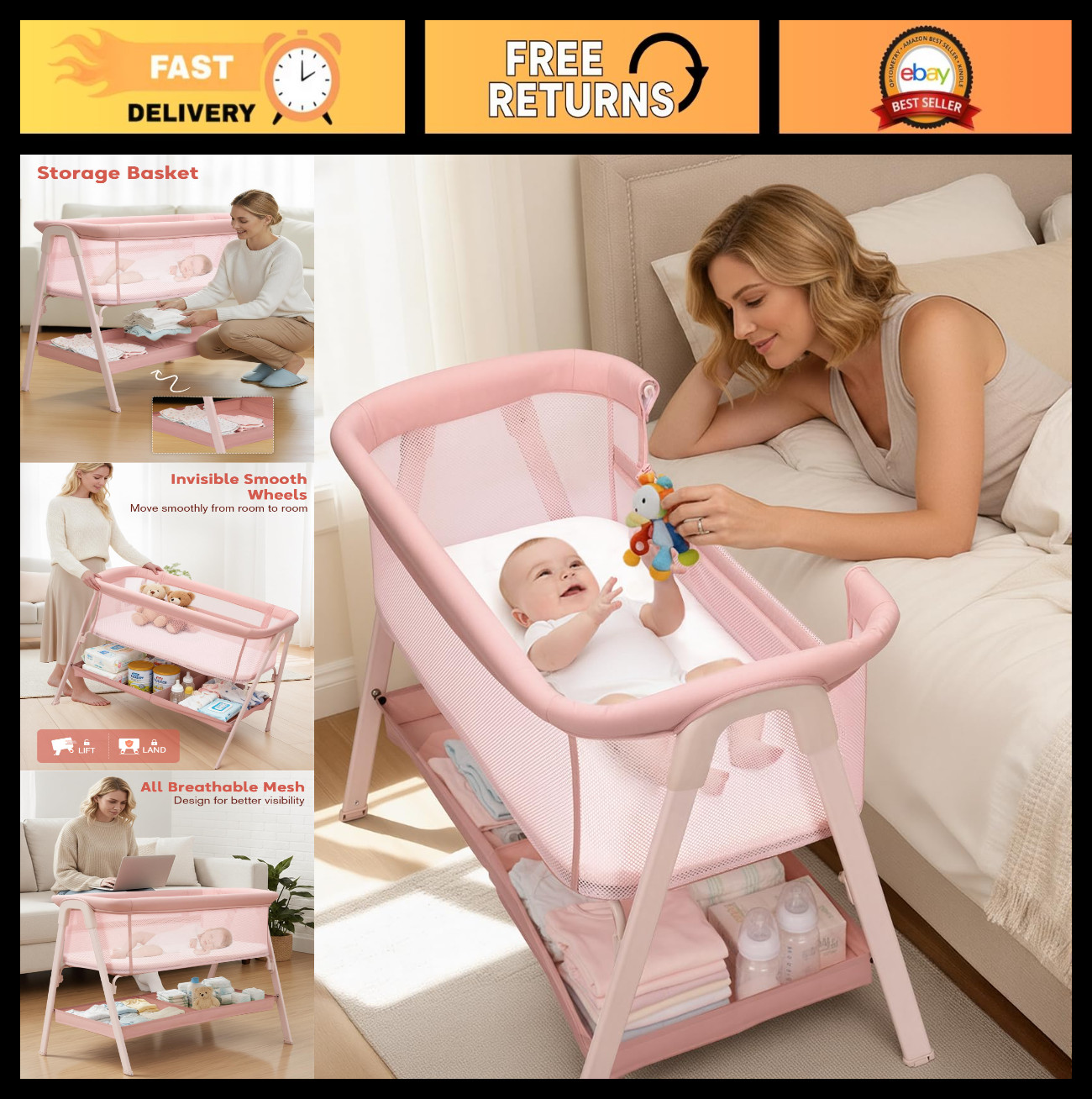

Photos from current listings. Actual item, color, and included accessories may vary.
Co Sleeper Cot Buying Guide
A co-sleeper cot is a bedside bassinet that attaches or aligns flush with the adult mattress so a parent can reach the baby without leaving bed, trading long-term furniture value for night-feed convenience and safe sleep proximity. The critical build trade-off is a rigid, breathable, correctly gapped sleep surface versus soft-sided or loosely anchored designs that create entrapment and fall hazards. Buy a cot with a firm flat pad, mesh sides, and a locking height-adjustable frame that mates to your bed; skip any model that relies on straps alone or a soft mattress.


At a glance
- Category
- Baby Sleep & Soothing
- Data updated
- Nov 16, 2026
Current offers
Highlights
- Bedside co-sleepers use a rigid frame with 4–6 height positions and a drop-side or zip-down wall; the mattress must sit flush with the adult mattress with no gap wider than 2 inches.
- Safe construction requires a firm, flat, breathable mattress pad and mesh side panels on all four sides; soft padded inners and bulky bolsters are suffocation risks under US CPSC and EU EN 1130 rules.
- Most co-sleeper cots are bassinet-stage only, rated to roughly 20–25 lb or until the baby can push up, so they are a first-6-months product, not a convertible crib replacement.
- Attachment methods split into strap-to-bed-rail, wedge-under-mattress, and stand-alone flush designs; stand-alone frames with locking casters are the most stable and the least dependent on your bed frame type.
Best use cases
- Best fit: breastfeeding or night-feeding parents who want the baby within arm's reach in the parents' room for the first six months — pick a height-adjustable mesh-sided model with a firm pad.
- Best fit: small bedrooms or travel where a full crib won't fit — choose a portable folding co-sleeper with a carry bag and a flat, rigid base rather than a soft-sided nest.
- Wrong fit: parents who want one purchase to last through toddlerhood — skip co-sleeper cots entirely and buy a convertible crib plus a separate bassinet for the early months.
- Wrong fit: beds with very low platforms, adjustable beds, or thick pillow-top mattresses — flush alignment is hard to achieve; a stand-alone bassinet at fixed height is the safer choice.
Buying tips
- Measure your adult mattress top height from the floor and buy a cot whose height range covers it with at least 2 inches of overlap; flush alignment prevents gaps and falls.
- Match the cot's attachment style to your bed: strap-and-anchor models need a visible side rail, while wedge-under-mattress models need a mattress you can lift and a solid base.
- Choose a firm, flat mattress pad with a removable washable cover and no memory foam or soft quilting; firmness is the single biggest safety spec in infant sleep.
- Prefer mesh side walls on all four sides and a locking frame with no pinch points; a drop-side should have a secure secondary latch, not just a zip.
Specs
| Attachment Type | Strap-to-rail / wedge-under / stand-alone |
|---|---|
| Height Adjustment | 4–6 positions, ~12–24 in range |
| Sleep Surface | Firm flat pad + 4-sided mesh |
| Stage Limit | Bassinet only, ~20–25 lb |
Related searches
What to check before buying
- Measure adult mattress top height and bed frame side-rail height; confirm the cot's height range spans that number.
- Check the gap between the cot wall and the adult mattress is under 2 inches after attachment, with no soft bedding or pillows bridging the seam.
- Confirm the cot pad is firm, flat, and sized to the frame with no more than 1 inch of gap around the edges.
- Verify the cot is rated for your baby's weight and stage, and that it has a stable base, locking wheels, and mesh on all sides.
FAQ
Data sources: eBay / Amazon listings and product attribute feeds Data updated Nov 16, 2026.
Some links on this page are affiliate links. If you buy after clicking one, we may earn a commission at no extra cost to you. This does not change which products appear here or their order. Affiliate disclosure.