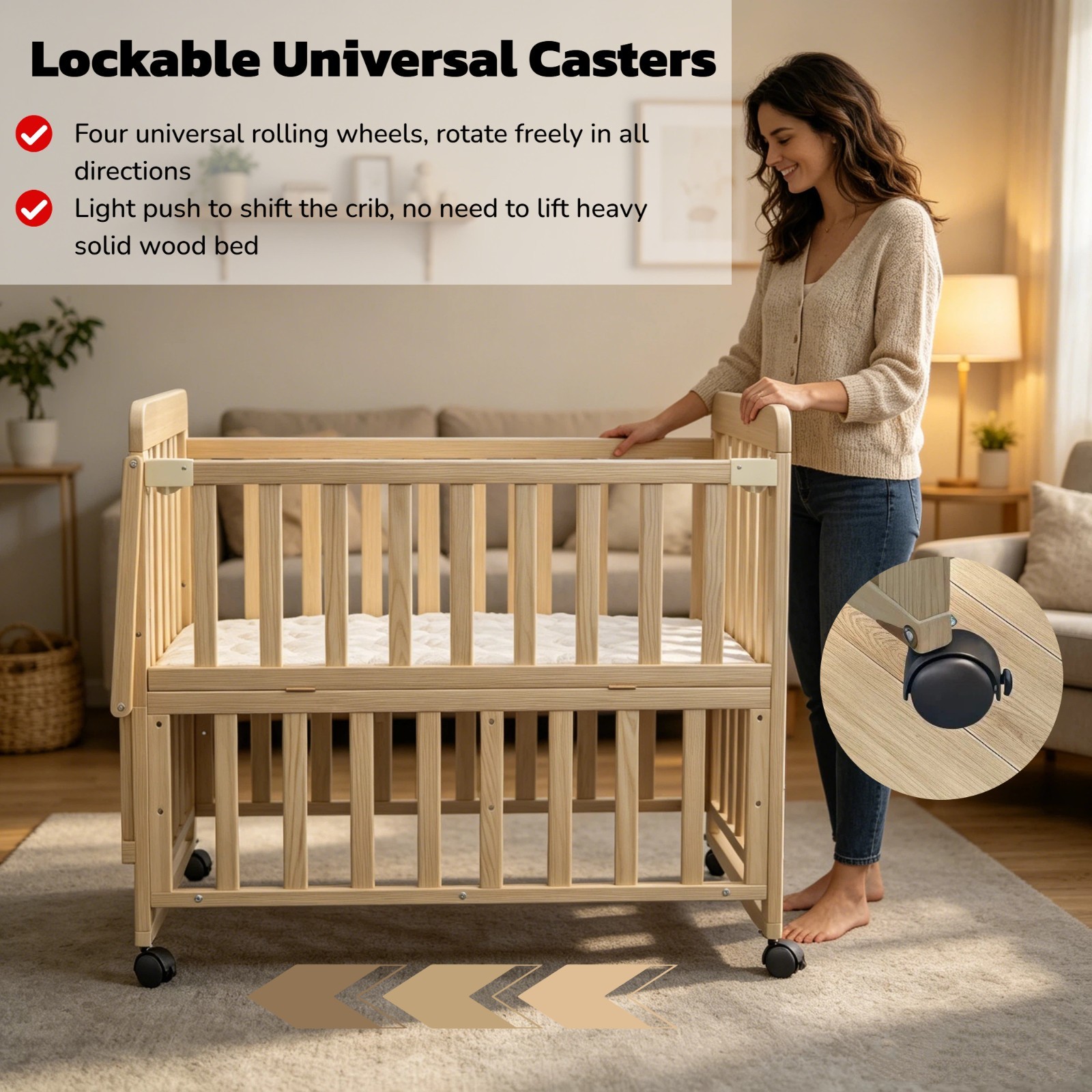

Photos from current listings. Actual item, color, and included accessories may vary.
Mini Crib With Wheels Buying Guide
Mini cribs with wheels solve the space-and-mobility problem for nurseries that need a full sleep station without a full-size footprint. Before buying, lock in the wheel type (locking casters vs. fixed), the crib's collapsed width for doorways, and whether the frame converts to a toddler bed or bassinet mode. Most buyer mistakes come from ignoring caster diameter and mattress thickness, which together determine whether the crib rolls smoothly and still meets safe-sleep mattress-fit rules.
At a glance
- Category
- Baby Sleep & Soothing
- Last updated
- Nov 22, 2026
Current offers
Highlights
- Mini cribs use a 24 in x 38 in mattress, smaller than the standard 28 in x 52 in crib, so sheets and mattress fit must be mini-specific.
- Locking casters are the norm; two locking wheels on a four-caster base let you park the crib securely while still steering it across a room.
- Solid-wood and hardwood frames hold screw threads and caster sockets better than particleboard; MDF is acceptable only when hardware is reinforced.
- 4-in-1 and 5-in-1 conversion tiers add toddler-bed and daybed modes; a bassinet insert raises the sleep surface for newborns before lowering to crib height.
Best use cases
- Best fit: a small apartment nursery where the crib must roll from bedroom to living room daily — choose locking casters and a frame width under 26 in for standard 30 in doorways.
- Best fit: a bedside-sleeper setup for the first six months — pick a mini crib with a bassinet insert and wheels that lock so it can sit flush against the adult bed.
- Wrong fit: a long-term single-bed purchase for a child past 18 months — a mini crib's 24 in x 38 in mattress is outgrown sooner than a full-size crib; step up to a standard convertible instead.
- Skip wheeled models on thick pile carpet or across thresholds; small casters bind and the frame can rack, so choose a stationary mini crib in those rooms.
Buying tips
- Check caster diameter and material: 2 in or larger rubber or polyurethane wheels roll over rugs and hardwood without marring, while 1 in hard plastic casters catch on seams.
- Prioritize locking casters on at least two wheels so the crib stays parked during sleep and feeding rather than drifting.
- Verify the mattress is a mini crib size (24 in x 38 in) and no more than 6 in thick; a loose or oversized mattress creates a gap that violates safe-sleep guidance.
- Choose solid wood or hardwood over MDF for the frame and caster mounting blocks, because repeated rolling stresses screw sockets.
Specs
| Mattress Size | 24 in x 38 in mini crib |
|---|---|
| Caster Type | Locking vs fixed, 2-4 wheels |
| Frame Material | Solid wood / hardwood vs MDF |
| Conversion Tier | Bassinet / crib / toddler / daybed |
Related searches
What to check before buying
- Measure every doorway and hallway turn on the route the crib will travel; the assembled width must clear the narrowest opening with casters attached.
- Confirm the floor type: hardwood and tile suit standard casters, but thick carpet requires larger wheels or a stationary crib.
- Check the mattress thickness and sheet fit against the 24 in x 38 in mini standard before assembly, since a loose mattress is a safety failure.
- Verify the crib includes all conversion hardware (toddler rail, bassinet insert) and that the caster sockets are pre-installed or clearly marked.
FAQ
Data sources: eBay / Amazon listings and product attribute feeds. Updated Nov 22, 2026.
Some links on this page are affiliate links. If you buy after clicking one, we may earn a commission at no extra cost to you. This does not change which products appear here or their order. Affiliate disclosure.