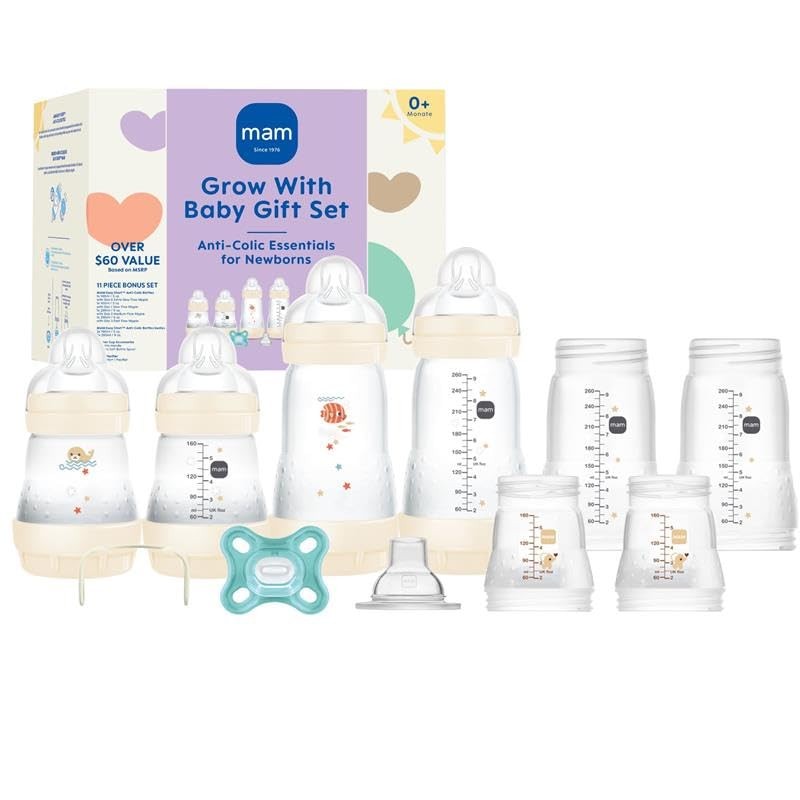

Photos from current listings. Actual item, color, and included accessories may vary.
Newborn Bottle Buying Guide
Newborn bottles are feeding vessels designed for infants 0–4 months, where the core trade-off is between anti-colic venting systems (which reduce air ingestion but add parts to clean) and simple, leak-resistant construction (easier to sanitize but less effective for colicky babies). The decisive rule: pick a bottle whose nipple flow rate and venting architecture match your feeding method (breast milk vs formula) and whose parts count you can realistically sanitize daily — skip any bottle that lacks a documented slow-flow nipple or uses hard polypropylene without a vent.


At a glance
- Category
- Feeding & Sterilizing
- Data updated
- Nov 19, 2026
Current offers
Highlights
- Anti-colic venting falls into three architectures: internal straw/vent tube (Dr. Brown's), bottom-vent air return (Playtex VentAire), and nipple-base vent (Philips Avent Anti-colic) — each changes part count and cleaning time.
- Nipple flow rates are staged by age: Level 1/Preemie (0–3 months, slow flow), Level 2 (3–6 months), Level 3 (6+ months); newborn feeding requires a documented slow-flow nipple or the baby will gulp air.
- Bottle material grades determine heat tolerance and chemical leaching: borosilicate glass (heat-shock resistant to ~150°C), PPSU (amber, autoclavable, ~180°C), and PP (translucent, ~100°C, replace every 3–6 months).
- A 15-piece gift set typically bundles 4–6 bottles, 2–4 nipples, a brush, and storage caps — the piece count reflects accessory breadth, not bottle quality; verify the included nipple levels match newborn slow flow.
Best use cases
- Best fit: formula-feeding parents who want minimal parts — choose a two-piece bottle with a nipple-base vent (e.g., Philips Avent Anti-colic) and a Level 1 nipple; skip internal-vent tubes if you dislike brushing narrow channels.
- Best fit: breast-milk feeding with pumped milk — pick a wide-neck bottle with a slow-flow nipple labeled Preemie or Level 1 and a storage-cap adapter; skip standard narrow-neck unless your pump flange is narrow-neck compatible.
- Best fit: colicky or gassy newborns — choose a fully vented system (internal vent tube or bottom vent) and accept 3–5 parts per bottle; skip single-piece bottles with no vent if the baby arches or gulps during feeds.
- Wrong fit: buying a 15-piece gift set before birth — nipple levels and bottle counts often exceed newborn needs; start with 2–4 bottles of one system and expand after the baby accepts the nipple.
Buying tips
- Match nipple flow to age: newborn 0–3 months needs a slow-flow (Level 1 or Preemie) nipple; a Level 2 or Y-cut nipple on a newborn causes rapid feeding and air swallowing.
- Count parts per bottle for sanitation: internal vent systems run 5–6 parts, nipple-base vents run 3–4, single-piece bottles run 2 — daily boiling or dishwasher cycles favor fewer parts.
- Choose material by cleaning method: glass and PPSU tolerate boiling and steam sterilization; PP bottles warp and cloud after repeated boiling and should be replaced every 3–6 months.
- Confirm pump compatibility: wide-neck bottles fit wide-neck pump flanges (Medela, Spectra) directly; narrow-neck bottles need an adapter ring — check the neck diameter (wide ~50mm, narrow ~40mm) before buying.
Specs
| Vent Architecture | Internal tube / bottom vent / nipple-base |
|---|---|
| Nipple Flow Level | Preemie–Level 1 (0–3 mo) slow flow |
| Bottle Material | Glass / PPSU / PP (BPA-free) |
| Neck Diameter | Wide ~50mm / Narrow ~40mm |
Related searches
What to check before buying
- Measure your sanitizing setup: confirm bottles fit your steam sterilizer or dishwasher basket — internal vent tubes and small caps need a basket with fine mesh.
- Check nipple level in the box: a newborn gift set must include Level 1 or Preemie nipples; sets with only Level 2+ require separate slow-flow nipple purchase.
- Verify bottle neck diameter against your pump flange: wide-neck (~50mm) vs narrow-neck (~40mm) determines whether you can pump directly into the bottle.
- Confirm material against your water hardness and cleaning routine: glass is inert but breakable; PPSU resists staining; PP is lightweight but degrades with boiling.
FAQ
Data sources: eBay / Amazon listings and product attribute feeds Data updated Nov 19, 2026.
Some links on this page are affiliate links. If you buy after clicking one, we may earn a commission at no extra cost to you. This does not change which products appear here or their order. Affiliate disclosure.