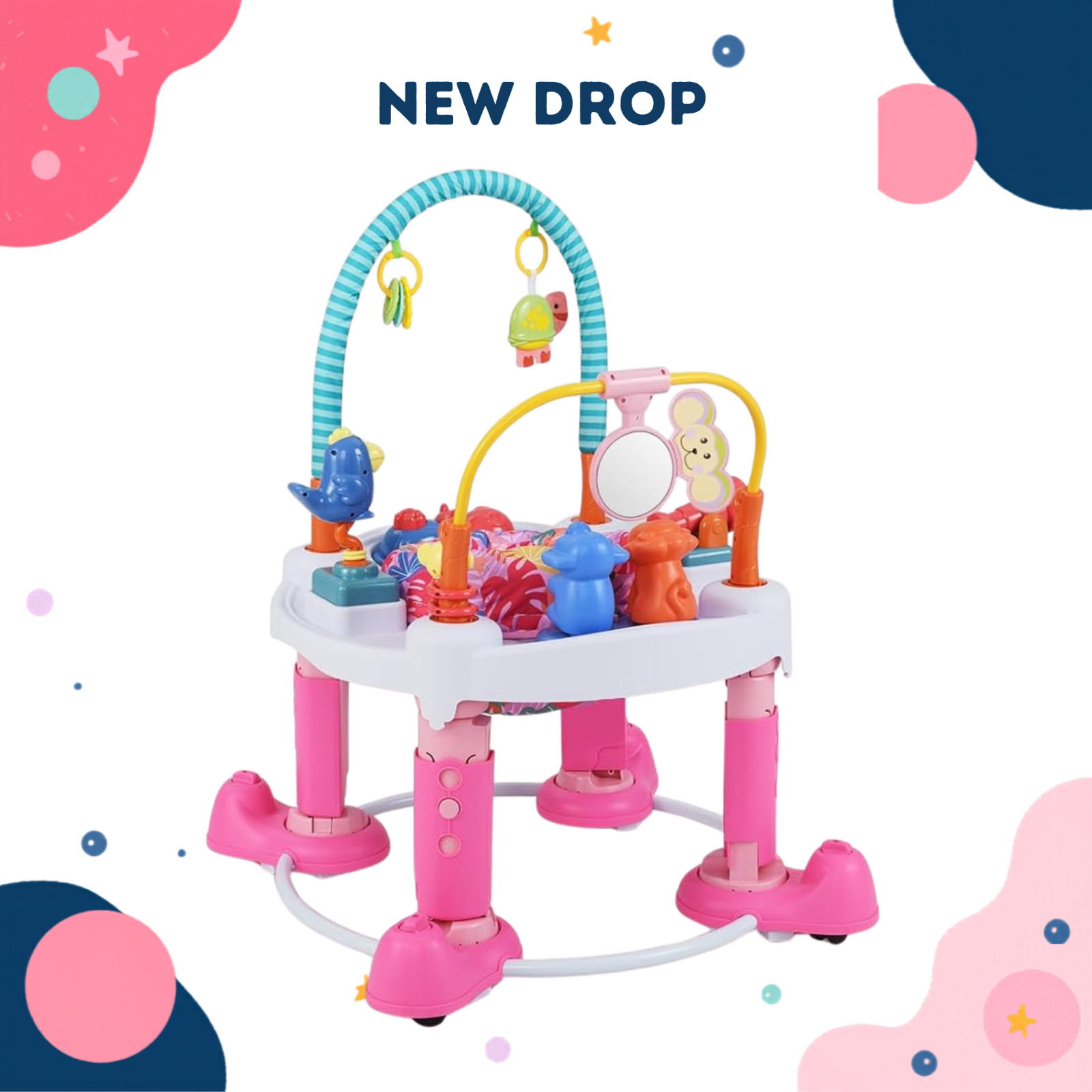

Photos from current listings. Actual item, color, and included accessories may vary.
Activity Walker Buying Guide
Activity walkers are mobile or stationary play stations that support pre-walking infants with seat suspension, floor reach, and toy trays; the core trade-off is between a rolling walker's mobility and a stationary activity center's safety and developmental fit. Durable options use height-adjustable seats, wide non-tipping bases, and ASTM F977-compliant braking, while compromises skimp on seat padding, use narrow bases, or lack adjustable height. Decision rule: pick a stationary or push-behind design for infants under 9 months, and only consider a rolling walker with a wide base and height adjustment.


At a glance
- Category
- Baby Toys & Activity Gear
- Data updated
- Nov 15, 2026
Current offers
Highlights
- Rolling walkers must meet ASTM F977 and federal safety rules; stationary activity centers are not governed by the same mobility standard and avoid stair-fall risk entirely.
- Seat height adjustment typically spans 3 to 5 positions; a properly fitted seat lets the infant's feet rest flat on the floor with knees slightly bent, not on tiptoe.
- Base footprint and wheelbase width determine tip resistance; wider bases with locking casters or resistance wheels reduce runaway speed on hard floors.
- 5-in-1 and multi-mode designs combine bouncer, activity center, walker, and rocker functions, but each mode's structural limits (weight capacity, seat recline) differ and are usually lower than single-purpose units.
Best use cases
- Best for pre-walking infants 6-12 months in a single-level home: a stationary activity center with adjustable seat height and a wide base; skip rolling walkers if there are stairs or uneven thresholds.
- Best for households with a large, fully carpeted or gated flat play area: a rolling walker with a wide footprint and resistance wheels; skip if the floor transitions between hard and soft surfaces.
- Best for tight apartments or multi-use gear: a foldable 5-in-1 activity center; skip fixed-frame full-size walkers if storage space is limited.
- Wrong fit: using a rolling walker before the infant can sit unassisted or on a different floor level; use a floor play gym or stationary seat instead.
Buying tips
- Measure the seat height range against your infant's inseam: the lowest seat setting should let feet touch the floor with a slight knee bend, and the highest should fit a 12-month-old.
- Check the base width: a footprint under roughly 24 inches across is easier to tip; prioritize wider bases with locking or resistance wheels for hard floors.
- For multi-mode 5-in-1 units, verify the weight limit for each mode; the bouncer mode often caps lower (around 20-25 lb) than the walker mode.
- Confirm the folding mechanism locks securely and the seat is wipe-clean and machine-washable; fixed fabric seats on low-end units are harder to sanitize.
Specs
| Walker Type | Rolling walker / Stationary / 5-in-1 |
|---|---|
| Seat Height Positions | 3-5 adjustable positions |
| Safety Standard | ASTM F977 (rolling walkers) |
| Weight Capacity | 20-25 lb per mode typically |
Related searches
What to check before buying
- Measure the doorway and play-area width: the walker's widest base dimension must clear thresholds and gates with at least an inch to spare.
- Check floor type: hard floors need resistance or locking wheels; thick carpet may require a walker with larger wheels or a stationary center instead.
- Verify the infant's developmental stage: seated head control and ability to sit unassisted are prerequisites for walker or activity-center use.
- Confirm the unit's assembled dimensions and folded size fit your storage space and vehicle if it will be transported.
FAQ
Data sources: eBay / Amazon listings and product attribute feeds Data updated Nov 15, 2026.
Some links on this page are affiliate links. If you buy after clicking one, we may earn a commission at no extra cost to you. This does not change which products appear here or their order. Affiliate disclosure.