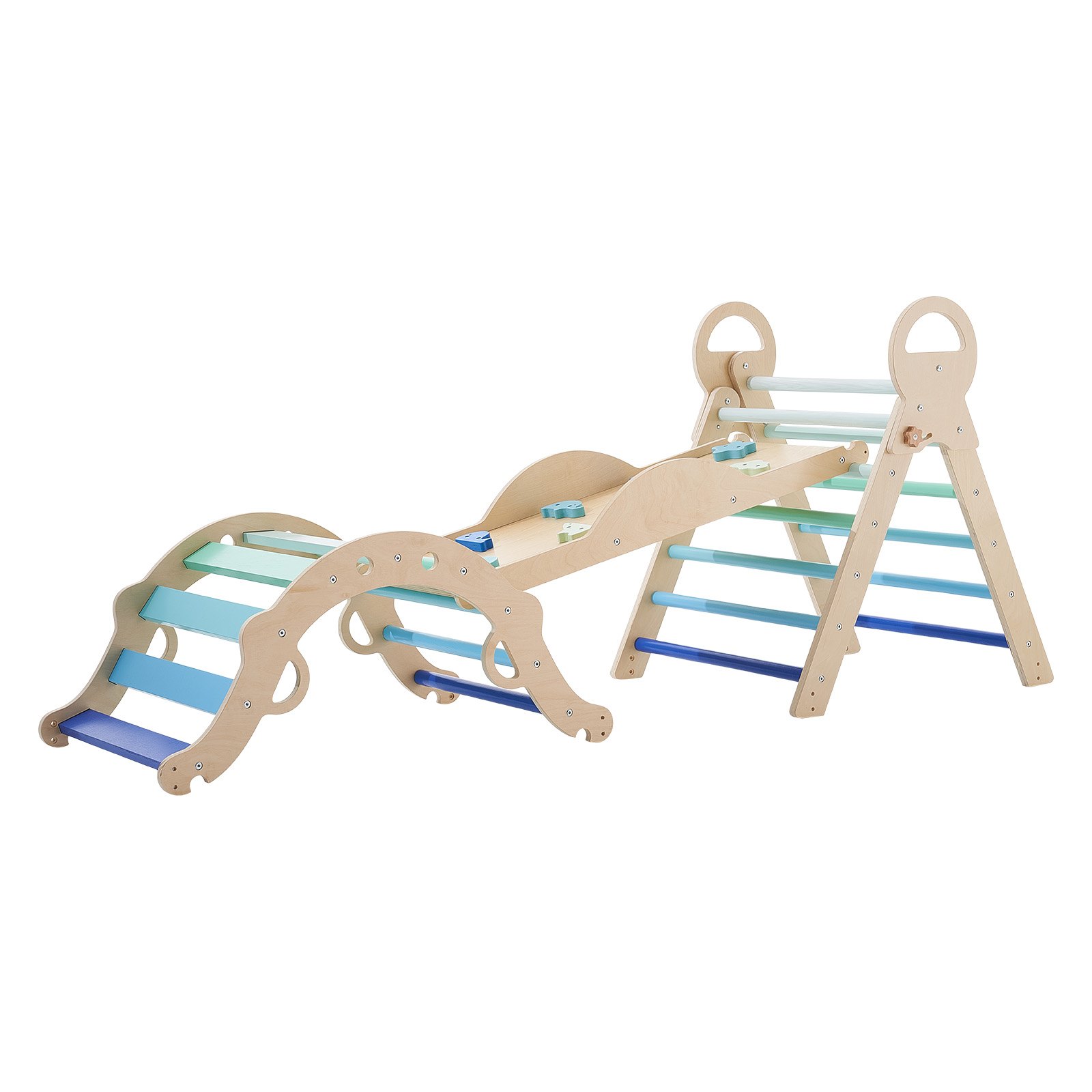

Photos from current listings. Actual item, color, and included accessories may vary.
Wooden Toy Buying Guide
Wooden toys for infants and toddlers range from simple grasping toys to large climbing structures, with the primary trade-off being wood grade and finish safety versus structural joinery and load rating. Durable options use solid hardwood (maple, beech, birch) with water-based, non-toxic finishes and reinforced joinery, while compromises rely on softwoods, MDF, or stapled joints that fail under climbing loads. The decision rule: buy solid hardwood with visible dowel-and-screw joinery and a stated load rating for active gear, and smooth, splinter-free, EN71/ASTM-certified finishes for mouthing infants.


At a glance
- Category
- Baby Toys & Activity Gear
- Data updated
- Nov 15, 2026
Current offers
Highlights
- Climbing frames rated 150 lbs use thicker rails (≥1.2 in) and cross-bracing; budget triangles often skip bracing and rely on friction-fit rungs.
- Solid beech or maple with water-based lacquer meets EN71-3 and ASTM F963; MDF or particleboard cores are not suitable for teething or climbing.
- Montessori Pikler triangles come in three sizes (small ~24 in, standard ~32 in, large ~37 in base) and must match ramp length for safe angles.
- Joinery quality separates tiers: through-bolts with barrel nuts and wooden dowels outlast stapled or glued butt joints under repeated climbing.
Best use cases
- Best for active toddlers 1–3 years: a solid-wood Pikler triangle with 150 lb load rating, non-slip rungs, and a reversible ramp/climbing board.
- Best for infants 0–12 months: smooth hardwood rattles, teethers, and stacking rings with rounded edges and food-grade or water-based finishes—skip climbing gear until sitting is stable.
- Skip large climbing sets for apartments under ~400 sq ft or homes without a soft landing zone; choose a small triangle or foldable arch instead.
Buying tips
- Match triangle base length to ramp length: ramps should span the rung span without overhang; a 32 in base needs a ~32 in ramp for a safe 30–40° angle.
- Choose solid hardwood (beech, maple, birch) over pine or MDF for climbing toys; softwoods dent and splinter under load.
- For mouthing infants, confirm EN71-3 or ASTM F963 certification and water-based, lead-free paint—avoid unknown finishes on teethers.
- Check fastener type: through-bolts with barrel nuts or recessed screws plus wood dowels are repairable and stronger than staples or brad nails.
Specs
| Wood Grade | Solid beech/maple vs pine/MDF |
|---|---|
| Finish Standard | EN71-3 / ASTM F963 water-based |
| Climbing Load | 150 lbs rated / cross-braced |
| Joiner Type | Through-bolt + dowel vs staple |
Related searches
What to check before buying
- Measure floor space and ceiling height: a standard Pikler triangle needs about 3 ft × 3 ft footprint plus clearance for the ramp.
- Place on a carpet, foam mat, or rug—hardwood toys on bare tile can slide and cause head injuries.
- Verify voltage/plug is not applicable; instead confirm all hardware is included and pre-drilled for assembly.
- For infants, check that no part fits through a small-parts cylinder (choking hazard) and that edges have a radius ≥0.1 in.
FAQ
Data sources: eBay / Amazon listings and product attribute feeds Data updated Nov 15, 2026.
Some links on this page are affiliate links. If you buy after clicking one, we may earn a commission at no extra cost to you. This does not change which products appear here or their order. Affiliate disclosure.